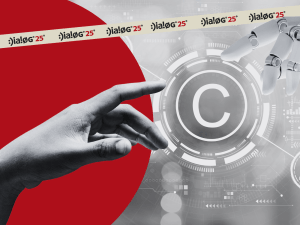
Who owns content on social media?
Social media and artificial intelligence have democratized creativity, but they have also brought the issue of copyright back into focus.


How generative AI is reshaping storytelling and why the human factor has never been more important.
The arrival of generative AI has marked a new chapter in the communications industry, but it has also highlighted something often taken for granted: the value of authentic human expression. Today, AI tools play an important role in speeding up content creation, structuring texts, and visualizing ideas that accelerate the creative process. One thing is certain: artificial intelligence should not replace the creative process—it should support it.
This raises the question: what happens to authenticity in an era of AI-generated content? Does authenticity lose its importance, or is it more crucial than ever?
Increasingly noticeable in everyday communication
The more we use AI in daily communication, the easier it is to recognize. This is especially evident on social media and in PR content, where AI-generated texts are linguistically correct and well-structured, yet they lack warmth, rhythm, personal perspective, and the human touch. Such content struggles to create genuine connections with audiences, which can impact trust in the messages being conveyed. The line between authentic storytelling and automated content may be thinner than before, but it has never been more important, as people instinctively recognize sincerity. That is why communications professionals must continue to rely on their own creativity, expertise, and professional skills—especially when conveying key messages or communicating in sensitive situations.
Protecting authenticity from artificial intelligence
As AI-generated content becomes more prevalent, transparency becomes a crucial issue. When content is fully created by AI, its origin should be clearly indicated. Visual AI materials are becoming increasingly convincing and can mislead audiences who lack the skills to detect generated elements, while texts may contain inaccuracies or unverified information since AI tools are not always reliable sources. Clearly labeling AI-generated content is therefore an important ethical standard that protects both audiences and the professional integrity of communicators.
A look into the future
We should use AI like a musician uses their instrument: as a tool that helps us express ourselves, while we remain in control. There is still significant room for AI to be regulated responsibly, both legally and ethically, in the business context. The future of storytelling in PR will depend on how wisely and responsibly we leverage AI to streamline everyday processes. It is likely that human creativity and personal input will be even more valued in an era flooded with AI-generated content, as only the human factor in storytelling can be truly sincere and authentic.

And be always updated with news from Dialog.
Social media and artificial intelligence have democratized creativity, but they have also brought the issue of copyright back into focus.
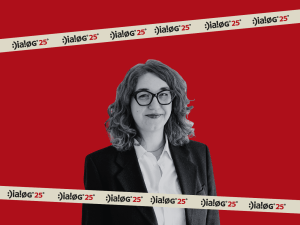
Dialog communications team welcomes Ines Madunić, Senior PR Executive.
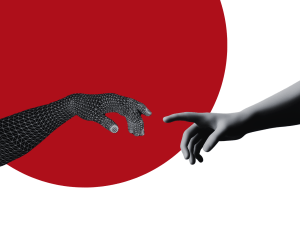
Regardless of the quality of AI content, credibility remains the biggest challenge.